Factsheet 9: Droughts and wetness


Droughts are among the costliest climate hazards with negative impacts for agriculture, the environment, and society. There is potential for worse droughts in the future due to changes in rainfall patterns and increasing temperatures under a changing climate. The Queensland Future Climate Science Program provides two indices and three metrics to evaluate changes to future droughts and wetness.
What is a drought?
In comparison to other natural hazards, the onset and severity of a drought are difficult to determine since droughts are characterised by a gradual build-up. It can take many months or years for the full extent and severity of a drought to become apparent. Definitions of a drought can be based on 3 broad concepts of drought:
- Meteorological droughts: relating to extended periods of below average rainfall that is exacerbated through high temperatures and evaporation.
- Hydrological droughts: describing impacts on streamflow and other water systems (e.g., reservoirs or lakes).
- Agricultural droughts: focussing on agricultural impacts, primarily through assessments of soil moisture.
What drought indices did we use?
The Queensland Future Climate Science Program focusses on meteorological droughts and wetness and presents information based on two of the more common meteorological drought indices, namely:
- Standardized Precipitation Index (SPI; McKee et al., 1993)
- Standardized Precipitation Evapotranspiration Index (SPEI; Vicente-Serrano et al., 2010)
SPI is a rainfall-based index, calculated from accumulated rainfall over a set number of months. SPEI is an extension of SPI, and also includes the impacts of increased temperatures through potential-evapotranspiration (PET). Rather than being calculated from accumulated rainfall, SPEI is calculated from the difference between rainfall and PET. It has been argued that SPEI better reflects changes to the overall water budget by considering the effects of changing atmospheric evaporative demand. The Queensland Future Climate Science Program adopts PET derived from the Penman-Monteith equation (Allen et al., 1998).
Both SPI and SPEI were calculated using an accumulation period of 12-months, as this was considered the timeframe most likely to have impacts on various hydrological and agricultural systems. Drought and wetness events are split into three different categories according to the severity (moderate, severe or extreme) as shown in Table 1:
Table 1. SPI and SPEI classification table following McKee et al. (1993)
| SPI/SPEI values | Categories | Probability of event (%) |
|---|---|---|
| SPI/SPEI ≥ 2.0 | Extreme wet | 2.3% |
| 1.5 < SPI/SPEI < 2.0 | Severe wet | 4.4% |
| 1.0 < SPI/SPEI < 1.5 | Moderate wet | 9.2% |
| -1.0 < SPI/SPEI < 1.0 | Near normal | 68.2% |
| -1.5 < SPI/SPEI < -1.0 | Moderate dry | 9.2% |
| -2.0 < SPI/SPEI < -1.5 | Severe dry | 4.4% |
| SPI/SPEI ≤ -2 | Extreme dry | 2.3% |
Metrics relating to the frequency of events, duration of events, and percent time in drought are calculated for each of the drought and wetness categories (extreme, severe, and moderate). These metrics show how drought and wetness characteristics will likely change in the future. A description of these metrics is presented below and an illustrated example provided in Figure 1.
- Frequency of events is the total number of events recorded over a given period.
- Duration of events is the average duration of recorded drought events (in months).
- Percent time in drought/wetness is the total time spent in a category of drought/wetness divided by the total time.

In addition to the three metrics above, timeseries of the extent of territory in drought or wetness (as a percentage) were also calculated for the different severity categories.
Droughts and wetness on Queensland Future Climate
The Queensland Future Climate Science Program has used state-of-the-art high-resolution downscaled climate simulations from both CMIP5 and CMIP6 global climate models to assess the impact of climate change on droughts and wetness. The CMIP5 information is provided using SPI only, while metrics based on both SPI and SPEI are available for CMIP6.
The main tools for viewing climate projections data on the Queensland Future Climate website are the Queensland Future Climate Dashboard and Regional Explorer. Please refer to the user guide for detailed information on how to access and interpret information available from these resources.
Examples of the drought information available on the Queensland Future Climate Dashboard and Regional Explorer are shown below.

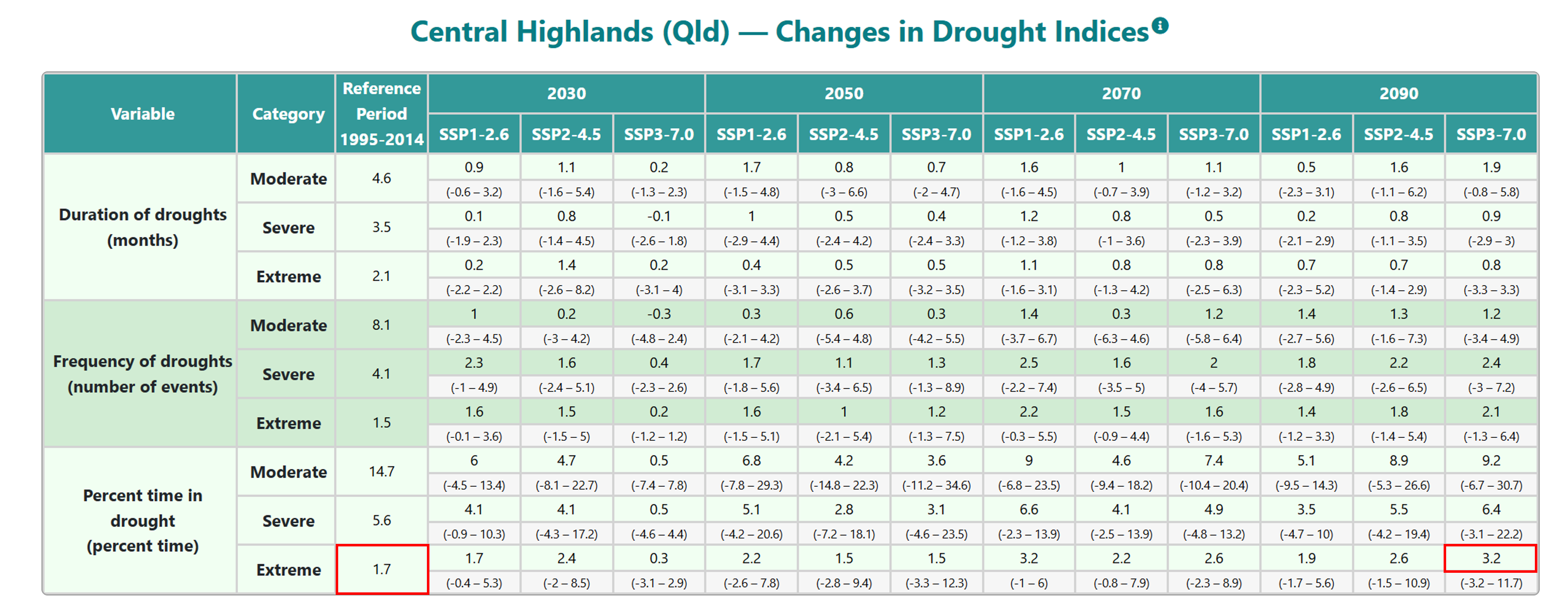
The CMIP6 Queensland Future Climate Dashboard and Regional Explorer Summary Tables provide access to data on the three drought/wetness indices mentioned previously: duration of droughts/wetness, frequency of droughts/wetness and percent time in droughts/wetness. The percent time in droughts/wetness variable is expressed as the percentage of the number of months in drought/wetness relative to the total number of months in the 20-year time-slice. It is important to note that changes in this variable represent an absolute increase in the percentage of months that are classified as droughts/wetness months, rather than a relative percentage increase. For example, under the SSP3-7.0 scenario, Central Highlands is projected to experience a mean increase in the number of extreme SPI drought months of 3.2% by 2090. This represents an increase from the reference value of 1.7% to a total projected percent time in drought of 4.9% (3.2% + 1.7% = 4.9%), which equates to approximately 12 months of extreme SPI drought during the 2080-2099 period under SSP3-7.0 (see figure below).
The drought/wetness index available for the Regional Explorer Timeseries charts differs from those used in the Queensland Future Climate Dashboard and Regional Explorer Summary Tables. This variation arises from the challenges associated with calculating duration, frequency, and the percentage of time in drought or wetness for individual years, as opposed to 20-year time slices. For both drought and wetness, the only variable available for selection as a timeseries chart is the extent of territory in drought/wetness (%). Unlike the indices in the other climate themes, the extent of territory percentages are displayed as actual values, not changes compared to a reference period. The Regional Explorer Timeseries charts offer several display options, including the ensemble mean and range, the mean and range for individual models, a comparison of results across the three emission scenarios and displaying the results for the three drought/wetness severity categories. When displaying the three severity categories, the timeseries is presented as a stacked chart, showing only the mean ensemble results for the categories without the range. For example, the chart below illustrates the mean projected extent of the Central Highlands LGA under moderate (9.7%), severe (11.5%) and extreme (13.2%) SPEI drought conditions in 2050 under SSP3-7.0, leading to a total area under drought of 34.4% (9.7% + 11.5% + 13.2% = 34.4%).

References
Allen, R. G., Pereira, L. S., Raes, D., & Smith, M. (1998). Crop evapotranspiration-Guidelines for computing crop water requirements-FAO Irrigation and drainage paper 56 (FAO, Rome, Vol. 300, p. D05109).
McKee, T. B., Doesken, N. J., & Kleist, J. (1993). The Relationship of Drought Frequency and Duration to Time Scales. Proceedings of the 8th Conference on Applied Climatology, 17.
Vicente-Serrano, S. M., Beguería, S., & López-Moreno, J. I. (2010). A multiscalar drought index sensitive to global warming: The standardized precipitation evapotranspiration index. Journal of Climate, 23(7), 1696-1718. https://doi.org/10.1175/2009JCLI2909.1.
